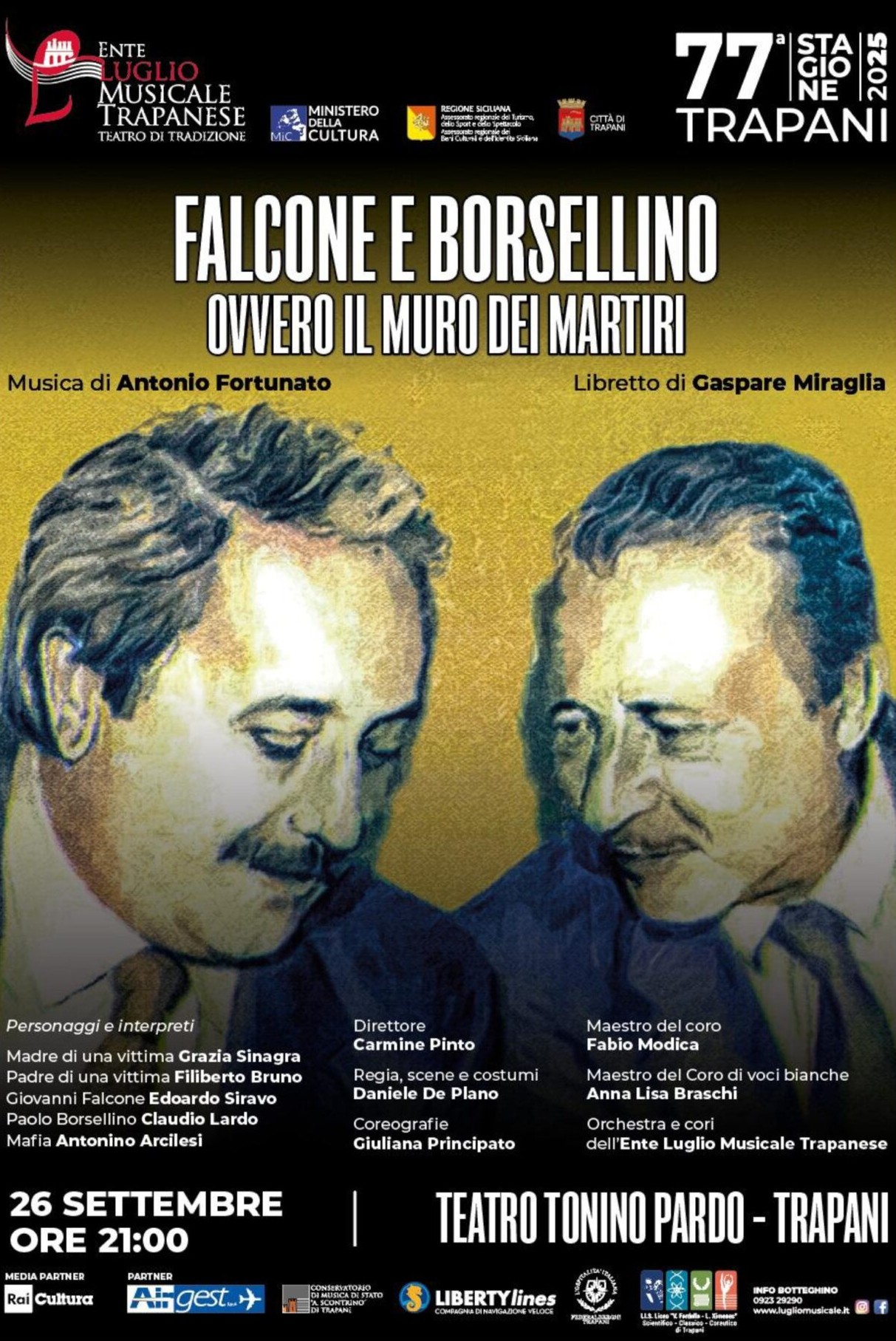
Falcone and Borsellino, or the Martyrs' Wall
music by Antonio Fortunato · libretto by Gaspare Miraglia
Claudio Lardo as Paolo Borsellino
My Role
In a work in which the other voices sing, Paolo Borsellino speaks: his is one of the two spoken roles, alongside Giovanni Falcone (Vito Cesaro). Their words run through Antonio Fortunato’s music and Gaspare Miraglia’s libretto, and give voice to the memory of the magistrates killed by the Mafia, in front of the Martyrs’ Wall.
Credits
The Production
To enter the theater tonight is to enter a place of memory and shared emotion. You will not find a set that faithfully imitates reality, but rather a symbolic space, a landscape of the soul that takes us into the heart of those terrible, unforgettable days. I conceived “Falcone and Borsellino” as an oratorio. The heart of the oratorio is the word set to music, amplified by the chorus and entrusted to the audience’s imagination.
Traditionally, the oratorio told biblical or religious stories, giving the chorus the task of being the voice of the community, of commenting on and echoing the events narrated by the soloists. It is no accident that, over the centuries, the oratorio has also become a place where music turns into civic memory, testimony, meditation on human destiny.
On stage rises a structure that recalls the Greek theater, the ancient cradle of the dialogue between man and destiny, between the individual and the community. It is there that the chorus finds its voice, made up of adults and children: a chorus that comments, questions, consoles. The pure voices of the children intertwine with the more mature ones, as if to remind us that memory does not belong only to the past, but lives and renews itself in the future.
At the side of the stage, a white tree. Its broken branches are scars, lives cut short, names we cannot forget. But that tree is not only a wound: it is also a root, the fragile and powerful image of an Italy that, in spite of everything, resists and blossoms again. In the background, a wall: the Martyrs’ Wall, from which the work draws its strength. Around the broken branches, five young dancers, students of the Liceo Coreutico (dance high school) of the City of Trapani, embody in movement what words cannot always say: fear and courage, silence and the scream, fragility and hope. The dance translates into movement the story told by the protagonists and by the music, turning tragedy into a poetic act that belongs to us. This show does not mean to be a lesson, but an encounter. An act of love and gratitude toward Giovanni Falcone and Paolo Borsellino, who taught us with their lives that justice and dignity are never a gift, but a daily choice. May the theater tonight become an embrace: a place to remember, but also to dream together of the possibility of a different future, free and peaceful.
Director’s notes by Daniele De Plano
Performances
- Trapani, Teatro “M° Tonino Pardo” – Conservatorio di musica “A. Scontrino” di Trapani
