Rousseau e la Serva padrona
a theatrical piece by Dora Liguori
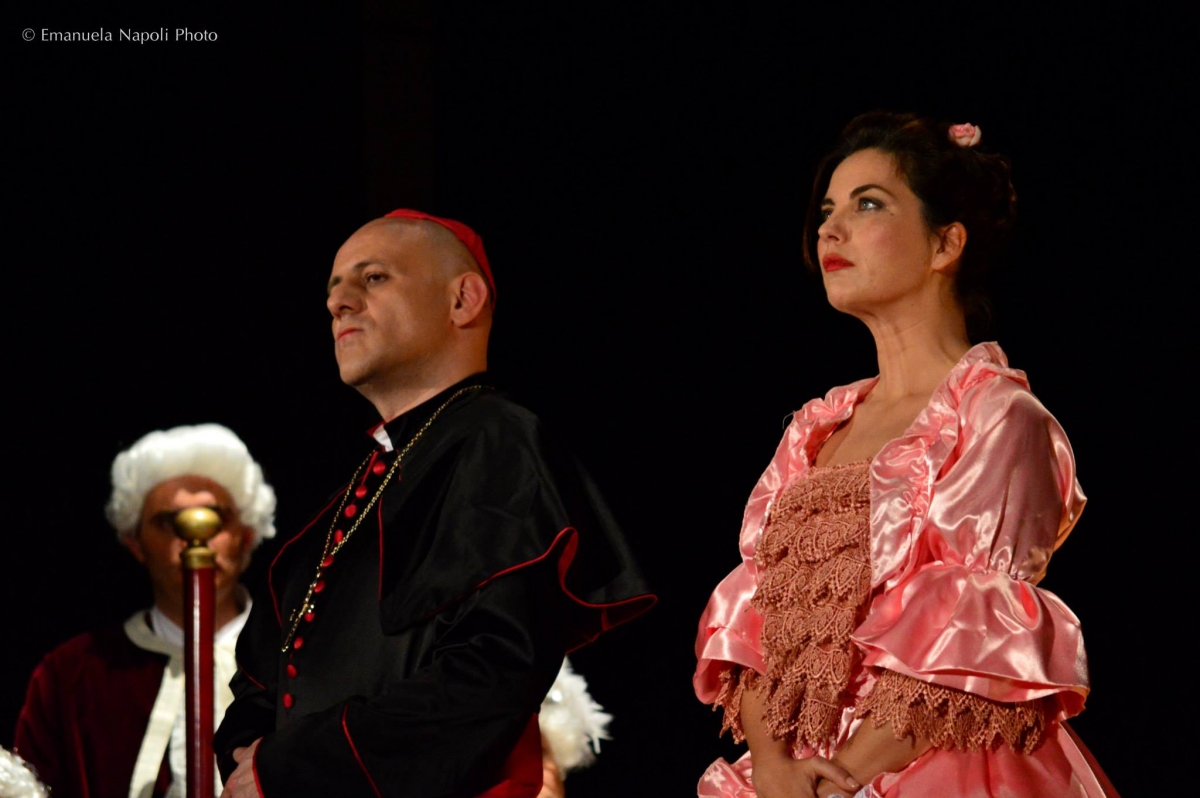
Claudio Lardo as Monsignor
Credits
The Production
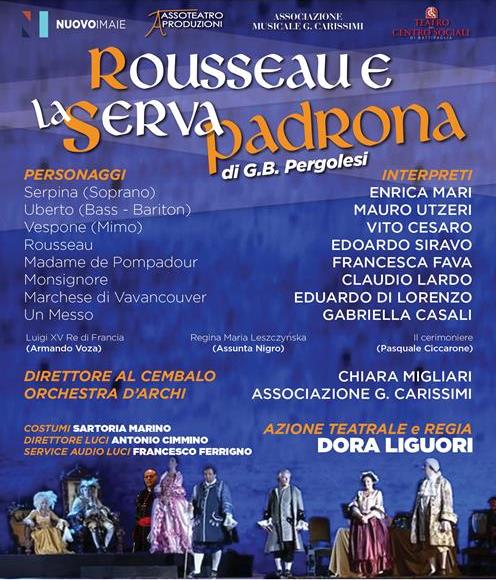
This is the story of the passionate defense that, in 1752, the French-Swiss philosopher, writer and musician Jean-Jacques Rousseau made in Paris of “La serva padrona” (The Servant Turned Mistress), which helped establish once and for all, around the world, the superiority of Italian music, or rather of the “Great Neapolitan School.” Remembering the commitment of the philosopher Rousseau, one of the fathers of the Enlightenment together with Voltaire, Diderot and d’Alembert, matters for younger generations too, since he was undoubtedly the founder of the idea of “modern democracy” and of man’s social and moral freedom: man who, as he put it, born free, cannot die in chains. These were precisely the principles the philosopher believed he found in the innovative text by Gennaro Antonio Federico (who wrote the libretto of La serva padrona), making it a metaphor for his idea of social revolution. It is no coincidence that the social content of La serva padrona, as Rousseau had sensed, would become, a few years later, a forerunner of the outbreak of the French Revolution.
Specifically, the theatrical action, followed by a complete performance of “La serva padrona,” sets out to reconstruct, in a highly entertaining yet philologically accurate way, what happened in Paris in the mid-18th century, when an Italian company led by Eustachio Bambini became, thanks to its fortunate encounter with Rousseau, so famous that it sparked a general dispute in Paris (which went down in history as the “Querelle des Bouffons”), which even brought King Louis XV of France to the theater, with the Queen, Madame de Pompadour and other dignitaries. That was the setting for a direct theatrical contest between French and Italian music; for the record: between Jean-Baptiste Lully’s “Acis et Galatée” and, of course, G. B. Pergolesi’s “La serva padrona.”
Naturally, King Louis XV handed victory to the French, forgetting that Italy would have won either way: Lully too, having been born in Florence, was not French but Italian.
Photos and Videos
Performances
- La Valletta (Malta), Teatru Manoel
- Battipaglia (SA), Teatro sociale “Aldo Giuffré”
- Corinaldo (AN), Teatro “Carlo Goldoni”
- Napoli, Teatro di Corte – Palazzo Reale